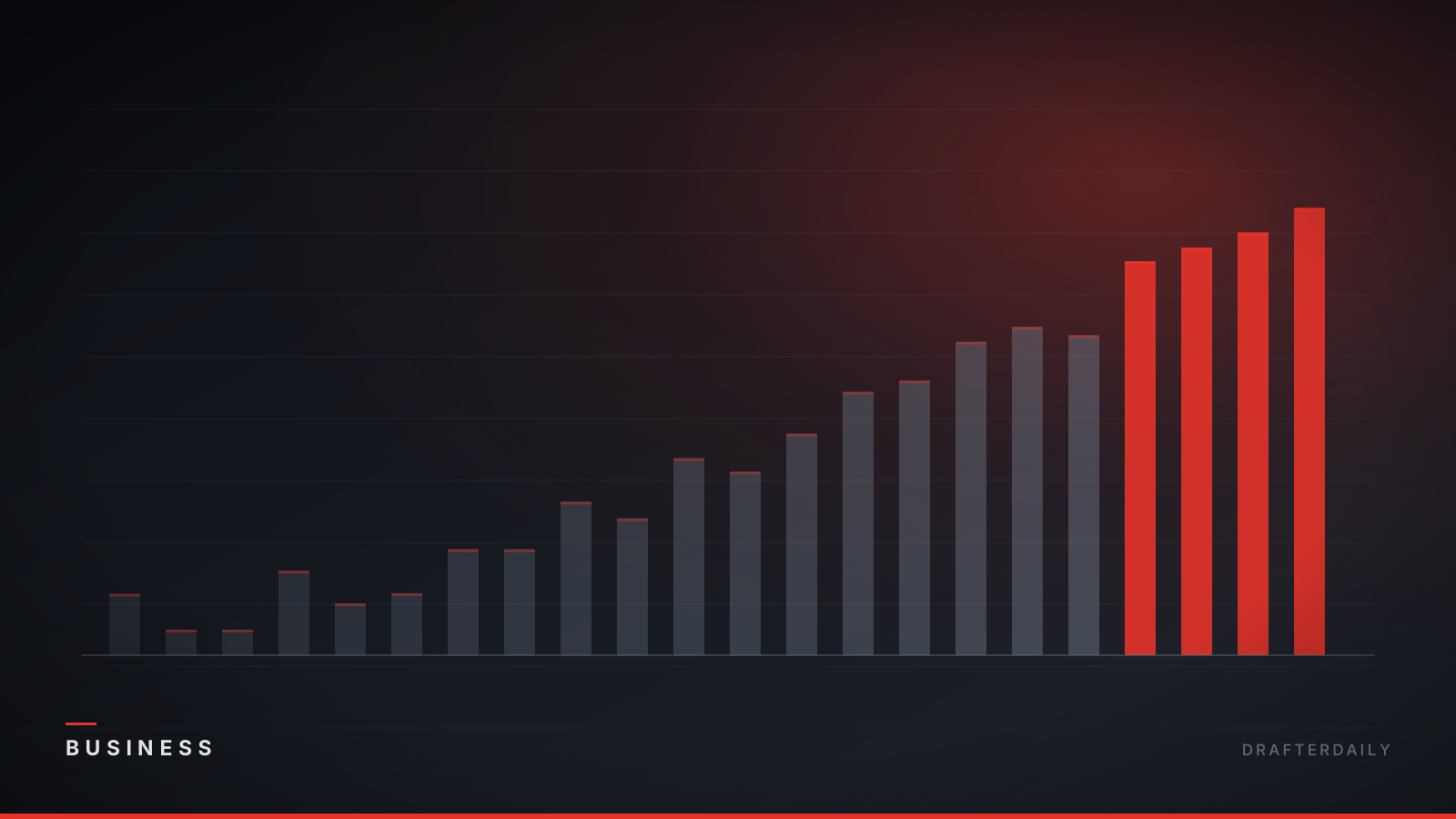
Who Actually Got the $510 Billion: Inside H1 2026's Record Venture Boom
The headline — record $510B in global startup funding — sounds like a rising tide. It isn't. OpenAI and Anthropic alone absorbed 43% of all capital. The real story is a two-speed venture market: AI megadeals at the top, cautious discipline everywhere else. Atlas maps where the money went and what it means for founders who aren't building foundation models.
Atlas Editorial··7 min readBusinessAI
The headline — record $510B in global startup funding — sounds like a rising tide. It isn't. OpenAI and Anthropic alone absorbed 43% of all capital. The real story is a two-speed venture market: AI megadeals at the top, cautious discipline everywhere else. Atlas maps where the money went and what it means for founders who aren't building foundation models.
The headline from Crunchbase's H1 2026 Global Venture Report reads like a bull market announcement: $510 billion in global startup funding, a record that exceeds the peak of the 2021 boom by roughly 15%. If you are a founder in the market for capital, it sounds like good news. It isn't — at least, not in the way you might hope.
The Record and What It Hides
OpenAI's $40 billion funding round closed in Q1 2026. Anthropic followed with a $15 billion round in Q2, partly structured as a strategic partnership with Samsung. Those two companies alone account for approximately $55 billion — 10.8% of all global venture funding in H1. Add in xAI, Together AI's $800M round, and several undisclosed hyperscaler commitments, and a single sector absorbed nearly half of all venture dollars.
The $510B number is accurate. The 'record venture boom' framing is misleading. What actually happened is one sector received unlimited capital. The rest of the market looks nothing like 2021.
The AI Concentration Effect
Why are OpenAI and Anthropic raising at numbers that would have been considered fantasy five years ago? The answer is rational capital deployment toward a once-in-a-generation platform shift. The hyperscalers are investing billions in compute infrastructure. The model companies that run on that compute are capturing the value layer above it. The investors who missed the internet are not going to miss this.
OpenAI: ~$40B raised H1 2026 — foundation model + enterprise distribution
Anthropic: ~$15B — foundation model + government/enterprise + Samsung chip partnership
xAI: undisclosed billions — foundation model + X platform integration
Together AI: $800M — open-source AI infrastructure and inference
SpaceX: IPO at $1.77T — satellite internet + launch infrastructure
What the Rest of the Market Looks Like
Strip out the AI megadeals and the venture market looks very different. Deal counts in traditional SaaS are down approximately 30% from 2021 peaks. Median seed valuations have compressed from $12M to $8-9M. Series A close rates are near decade lows. The sectors showing genuine health outside AI infrastructure: defense tech, climate infrastructure, and healthcare AI — applied tools for clinical workflows, not foundation models.
What Founders Should Do With This Information
If you're building AI-adjacent (but not a foundation model): the most fundable position is a vertical AI application with proprietary data and a clear enterprise customer base. Healthcare administration, legal discovery, financial compliance, and manufacturing quality control are all seeing real enterprise deals.
If you're building something that has nothing to do with AI: demonstrate that you're using AI tools in your product and operations — this is table stakes now. Show proprietary data, regulatory relationships, or distribution advantages that a well-capitalized AI company couldn't easily replicate. And show revenue. The single most effective thing non-AI founders can do is generate revenue that proves market existence.
“The best time to be a non-AI founder is right now, if you can articulate why your defensibility comes from something AI can't easily replicate: proprietary data, regulatory relationships, physical infrastructure, or human trust.”
The Exit Market: What SpaceX's IPO Signals
SpaceX's IPO at $1.77 trillion validates the public market appetite for infrastructure businesses with genuine monopoly-like positions in critical industries. The companies that went public in 2026 share a common characteristic — they have defensible businesses, not just growth stories. For most founders, the practical implication is that the path to exit has lengthened. Plan for 8-12 years to IPO rather than 5-7. Build for profitability before the public markets will welcome you.
Frequently Asked Questions
Harder, for most companies. Typical seed round sizes have compressed and close rates are lower. The exception is AI-related companies with a clear enterprise use case and early customer validation — these are still seeing competitive seed processes. For everything else, expect a longer fundraising timeline and lower valuations than 2021 benchmarks suggested.
Get ahead of the market.
Atlas covers venture trends, startup strategy, and business intelligence — weekly, without the noise.
Professional-grade AI video and image generation used by major studios. Gen-3 Alpha produces cinematic video from text or image prompts with unmatched temporal consistency.
Enterprise-grade AI writing assistant trained on 10+ years of top-performing content. Best-in-class for brand voice consistency across long-form articles and campaigns.
Nvidia is in talks to guarantee $250B in debt for OpenAI's Ohio mega-campus — because conventional debt markets won't. Here's what that tells you about the economics of frontier AI.