Two AI Labs Took 43% of All Global Venture Capital in H1 2026. Here's What That Means.
Global VC hit a record $510B in H1 2026, but OpenAI and Anthropic alone took $217B of it. This piece examines what that concentration means for non-AI founders, LPs, and whether the current funding pattern is sustainable.
DrafterDaily Editorial··7 min readBusinessAIInvesting
Global VC hit a record $510B in H1 2026, but OpenAI and Anthropic alone took $217B of it. This piece examines what that concentration means for non-AI founders, LPs, and whether the current funding pattern is sustainable.
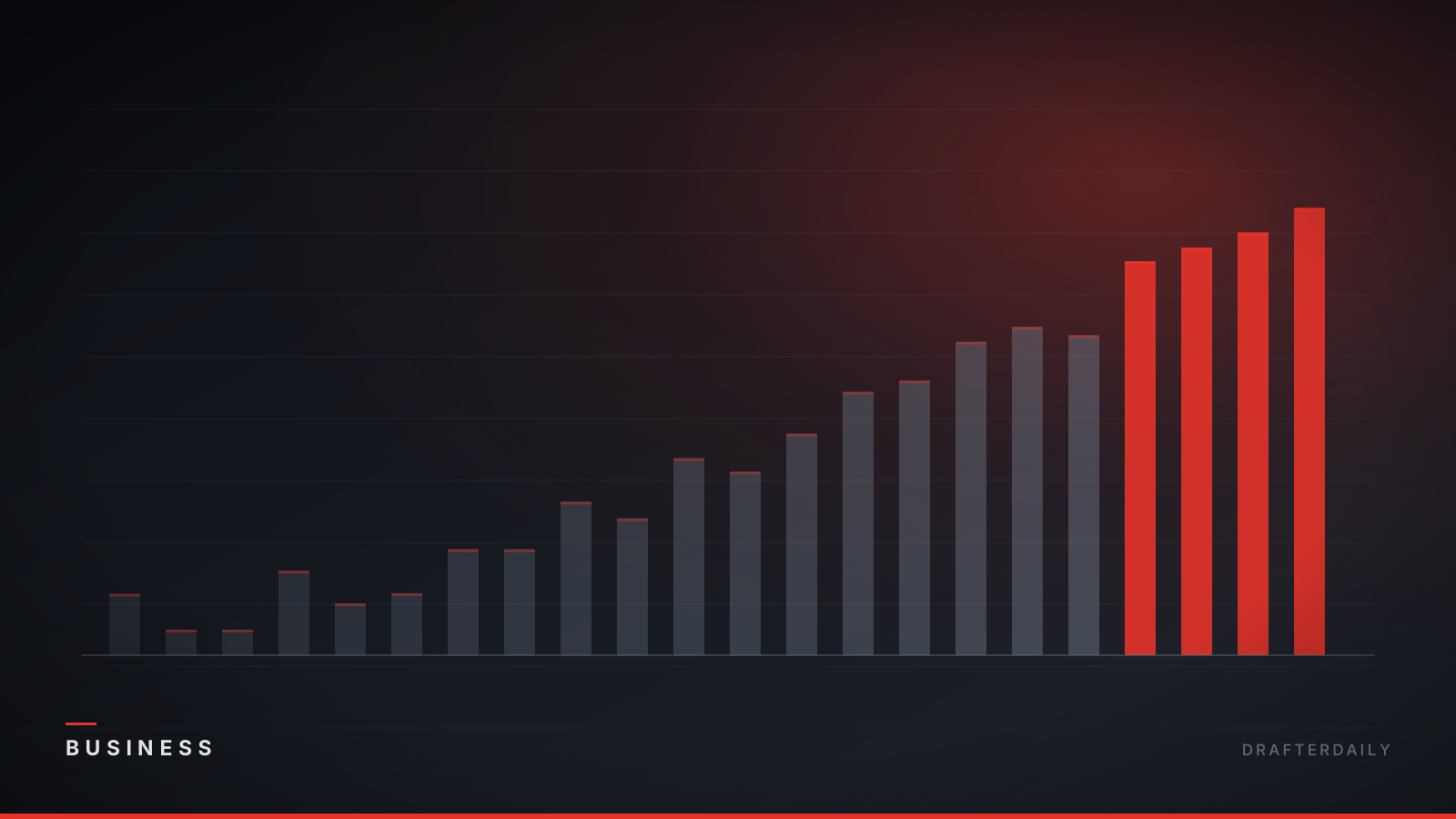
Global venture capital hit a record $510 billion in the first half of 2026—a headline that, on its own, reads like unambiguous good news for the startup economy. Look one level deeper and the picture changes. OpenAI and Anthropic alone absorbed roughly $217 billion of that total, or about 43% of all venture capital deployed globally across every sector, every stage, and every geography, in six months. Two companies. Nearly half the world's venture capital. What that concentration means for the thousands of other startups competing for the remainder is the more important, and far less discussed, story.
The Record: $510B and What's Really Driving It
To put the H1 2026 number in context, it eclipses the full-year totals of most years in the last decade, and it's on pace to make 2026 one of the largest years for venture funding on record—rivaling or exceeding the peak of the 2021 bubble. But the composition is fundamentally different. The 2021 boom was broad-based: SaaS, fintech, consumer apps, crypto, and biotech all raised at elevated valuations simultaneously. The 2026 boom is narrow and concentrated, driven almost entirely by a handful of frontier AI labs raising at valuations that would have seemed implausible even two years ago.
The Concentration Problem: When Two Companies Take 43%
A 43% concentration in two companies is a genuinely unusual market structure for venture capital, an asset class built on the premise of diversification across a portfolio of bets, most of which fail. When LPs allocate a growing share of their venture exposure to funds that are, in turn, concentrating capital into OpenAI and Anthropic—whether directly or through the growth-stage vehicles increasingly built around them—the diversification benefit that venture capital is supposed to provide starts to erode. You end up with what amounts to a bet on two companies dressed up as a diversified asset class.
“When two companies absorb this much of the available capital, every other founder is effectively competing for what's left over—and what's left over is being allocated with far more caution than the headline $510B number suggests.”
The Compounding Advantage
Capital concentration compounds. OpenAI and Anthropic's massive raises let them outbid every other AI company for the specialized engineering and research talent required to build frontier models, which in turn produces better products, which in turn justifies the next, larger raise. This dynamic isn't new to venture capital—market leaders have always attracted disproportionate capital—but the scale and speed at which it's happening in AI is without recent precedent, and it's reshaping how LPs think about risk in the category entirely.
What It's Like to Raise Outside AI Right Now
Founders building outside frontier AI describe a materially harder fundraising environment than the headline $510B figure implies. A few patterns are consistent across sectors:
Seed and Series A rounds outside AI are taking longer to close and requiring more traction proof points than in 2023–2024, as generalist funds redirect partner attention toward AI opportunities.
Biotech and climate tech have held up relatively well, partly because they require domain-specific expertise that's harder for AI-focused funds to redirect toward, and partly because of genuine scientific breakthroughs attracting dedicated capital pools.
Defense tech has emerged as one of the few non-AI categories seeing funding acceleration, driven by geopolitical tailwinds and government demand signals independent of the broader AI cycle.
'AI-adjacent' framing has become a fundraising necessity for many founders outside the category—positioning a product as an AI application layer, even a thin one, meaningfully improves access to capital compared to a purely traditional software or consumer pitch.
The practical signal for founders: capital is not scarce in aggregate, but it is scarce and selective outside a narrow set of categories. Positioning, sector choice, and even how a pitch is framed now matter more for fundraising success than they did two years ago.
Is This Sustainable? The Case For and Against
The bull case for continued concentration rests on the idea that frontier AI labs are building genuinely new infrastructure—the equivalent of railroads or electrical grids—and that early scale advantages compound into durable moats that justify outsized capital allocation. Recent proof points support this: the SpaceX IPO reaching a $1.77 trillion valuation and the $60 billion Cursor acquisition both suggest investors believe scale itself is the moat in this cycle, not just product quality.
The bear case is more familiar: extreme capital concentration has preceded painful corrections before, and valuations built on continued exponential capital inflows are fragile if that inflow slows even modestly. If AI lab valuations were to compress meaningfully, the ripple effects would extend well beyond the two companies themselves—to the LPs overexposed to the category, the growth funds built around late-stage AI access, and the broader venture ecosystem that has quietly reoriented itself around a handful of outcomes.
The $510 billion headline is real, but it obscures more than it reveals. For founders outside the two companies absorbing nearly half of it, the practical reality is a more selective, more competitive fundraising environment than the record-breaking topline number suggests—and for investors, the concentration itself is becoming the central risk to underwrite, not a footnote to an otherwise bullish story.
Frequently Asked Questions
OpenAI and Anthropic dominate the H1 2026 funding data, together absorbing roughly $217 billion of the $510 billion raised globally—about 43% of all venture capital deployed in the first half of the year. Outside frontier AI labs, defense tech, biotech, and climate tech have been the strongest-performing categories for fundraising.
Understand Where the Capital Is Really Flowing
DrafterDaily tracks the business and investment stories that matter—beyond the headline numbers.
Professional-grade AI video and image generation used by major studios. Gen-3 Alpha produces cinematic video from text or image prompts with unmatched temporal consistency.
Enterprise-grade AI writing assistant trained on 10+ years of top-performing content. Best-in-class for brand voice consistency across long-form articles and campaigns.
Nvidia is in talks to guarantee $250B in debt for OpenAI's Ohio mega-campus — because conventional debt markets won't. Here's what that tells you about the economics of frontier AI.