On June 2, 2026, Anthropic filed confidentially for an IPO targeting an October Nasdaq listing at a $965 billion valuation — with investment bankers now citing secondary market pricing above $1 trillion as their base case. Goldman Sachs, Morgan Stanley, and JPMorgan are leading what is expected to be a $60 billion-plus raise — one of the largest in US stock market history. Anthropic grew annualized revenue from $1 billion at the end of 2024 to over $44 billion by May 2026, a 44x increase in 18 months. DrafterDaily breaks down what the 20x-plus revenue multiple means for public market investors, why Anthropic is moving ahead of OpenAI, and what the real risks are inside the headline valuation.
On June 2, 2026, four days after closing a $65 billion Series H funding round, Anthropic filed confidentially with the SEC for an initial public offering targeting a Nasdaq listing in October 2026. Goldman Sachs, Morgan Stanley, and JPMorgan are leading an offering that sources familiar with the process expect to raise more than $60 billion — which would make it one of the largest IPOs in the history of US capital markets. The company's valuation heading into that raise: $965 billion, the figure established by its Series H.
The number is large enough that it invites the usual responses — amazement, skepticism, or a reflexive comparison to the dot-com era. None of those responses is particularly useful for investors trying to understand whether the Anthropic IPO represents a genuine opportunity or a case of a hot asset priced to perfection at the top of a cycle. What is useful is understanding the actual mechanics: what is the business, what drove the revenue growth, what are the assumptions embedded in a $965 billion valuation, and what could go wrong. The AI industry has produced extraordinary numbers in 2026; the question is whether this is a company whose fundamentals justify one of the largest IPO valuations ever attempted.
The Numbers That Define the Offering
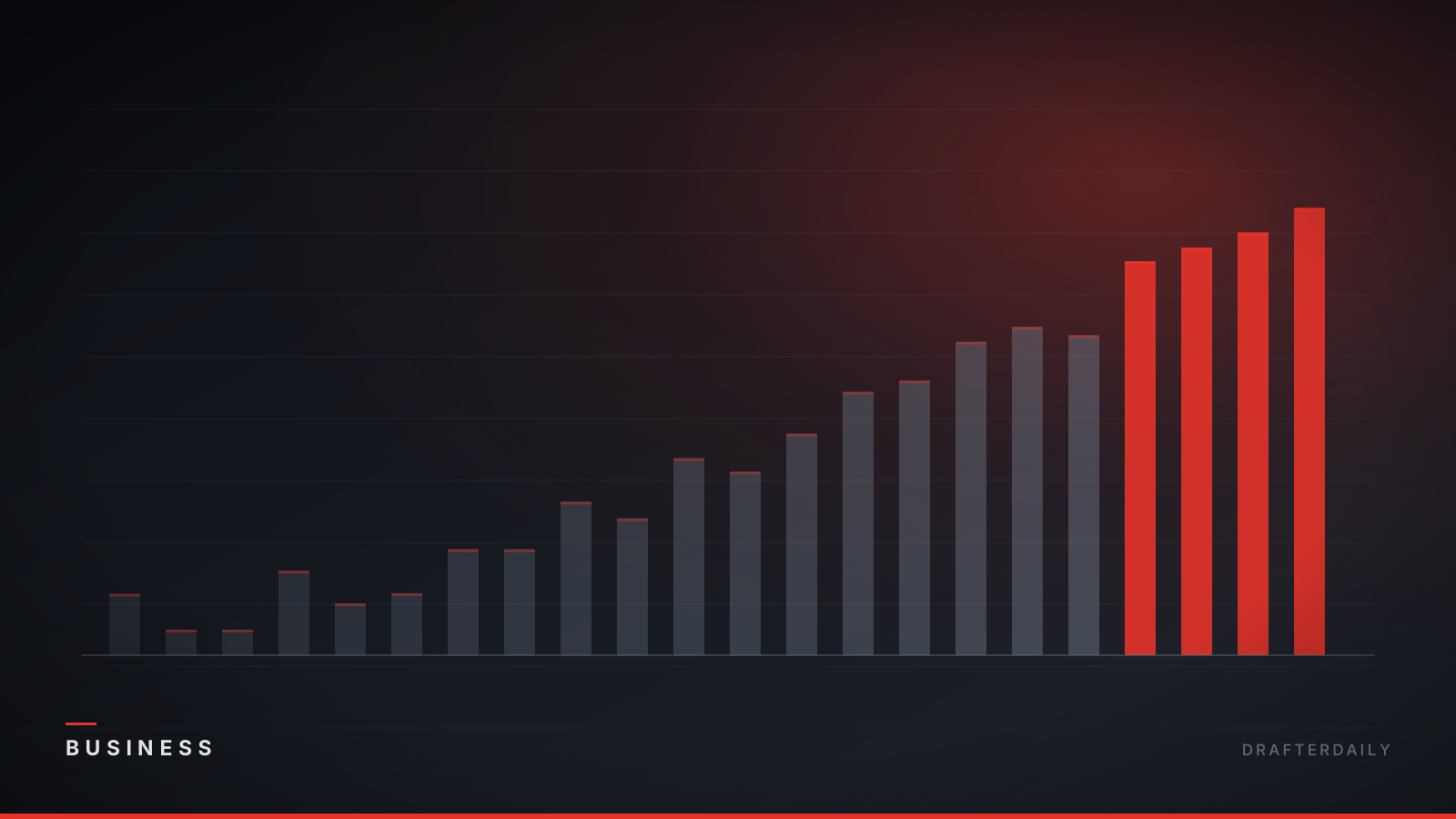
The most important fact about Anthropic's IPO is the revenue trajectory that built the case for a nearly-trillion-dollar valuation. At the end of 2024, Anthropic's annualized revenue was approximately $1 billion. By the end of 2025, that figure had grown to $9 billion. By April 2026, it had reached $30 billion. By May 2026, annualized revenue exceeded $44 billion. Those are not projections; they are the reported run-rate figures that Goldman Sachs, Morgan Stanley, and JPMorgan took into investor meetings when they began the pre-IPO roadshow process in July.
- End of 2024: ~$1 billion annualized revenue
- End of 2025: ~$9 billion annualized revenue (9x year-over-year growth)
- April 2026: ~$30 billion annualized revenue (3.3x in 4 months)
- May 2026: $44+ billion annualized revenue (44x growth from 18 months prior)
- October 2026 IPO target: $965 billion valuation — approximately 20x trailing annualized revenue
- Expected raise: $60+ billion, led by Goldman Sachs, Morgan Stanley, JPMorgan
For context on the multiple: at $965 billion and $44 billion in annualized revenue, Anthropic would be pricing at roughly 22x trailing revenue. The best public SaaS and cloud comps — Salesforce, Snowflake, ServiceNow — trade between 8x and 15x revenue in 2026. The closest analogues are high-growth AI infrastructure companies like Palantir, which trades at elevated multiples on the basis of its AI revenue acceleration. The bull case for a 20x-plus multiple on Anthropic is that AI revenue doesn't compound like traditional software revenue — it compounds faster, because every enterprise that adopts Claude or builds on Anthropic's API tends to expand usage quarter-over-quarter as it embeds the product deeper into its workflows.
What Is Driving the Revenue Growth
Three revenue streams drove the 44x growth: Claude API, Claude Code, and hyperscaler resale. The API business is the base layer — enterprises paying per token for access to Claude's reasoning and generation capabilities, with the Claude Sonnet and Haiku models (lower cost) driving most of the volume and the Opus-tier models (higher margin) driving most of the revenue per token. Enterprise API contracts, typically multi-year with committed consumption floors, are the stickiest part of the business and the most predictable.
Claude Code — Anthropic's autonomous coding agent — is the fastest-growing product line and the one most cited in Anthropic's investor materials as the expansion catalyst for 2026 and beyond. Software engineering is one of the highest-value use cases for AI because the output is directly measurable (working code) and the economic value of acceleration is clear. Claude Code's adoption inside enterprise software development teams, combined with IDE integration and GitHub Copilot-competitive positioning, has driven annualized contract values that are meaningfully higher than the API alone.
The third stream — hyperscaler resale — is the most interesting for understanding the competitive dynamics. Both Google Cloud and Amazon Web Services resell access to Claude models through their AI marketplace offerings, giving Anthropic distribution to enterprise customers who prefer to consolidate cloud relationships rather than add a new vendor. The Google backstop arrangement — in which Google has agreed to guarantee lease payments at five data center locations on Anthropic's behalf, providing approximately $35 billion in contingent credit support — is both a sign of how seriously Google treats Anthropic as a strategic asset and a source of concentration risk for investors thinking about governance.
Why Anthropic Is Moving Before OpenAI
The strategic context for Anthropic's October listing is as important as the financial data. OpenAI, the larger and better-known competitor, had also been expected to go public in 2026. As of July 2026, OpenAI's CFO Sarah Friar has advocated internally for delaying the IPO to 2027, citing the company's spending commitments and the time needed to meet public-company reporting requirements at scale.
For Anthropic, that delay creates a first-mover window in the 'AI IPO' investment category that may not stay open long. Institutional investors have limited budget for new-category exposure; the first major AI company to go public captures the category allocation before investors need to decide between competing offerings. If OpenAI lists in 2027 at a potentially higher valuation and with more revenue, investors who bought Anthropic at IPO will be comparing their returns against a subsequent offering. Anthropic's window to lock in that positioning before OpenAI enters the public market closes in late 2026.
The 20x Multiple: Bull Case and Bear Case
A note on the valuation baseline: $965 billion is the figure established by Anthropic's May 2026 Series H funding round — the last official, company-validated data point. Secondary market trading of Anthropic shares in July 2026 implies a higher valuation, with investment banks and secondary platforms reporting trades that imply $1.05 trillion to $1.15 trillion. Goldman Sachs and other lead underwriters are reportedly working from a base case of a debut above $1 trillion. DrafterDaily uses the $965 billion Series H figure throughout this piece as the confirmed reference point; investors should be aware that the IPO may be priced above this, which would increase the revenue multiple and the valuation assumptions in this analysis.
At a 20x-plus revenue multiple, Anthropic's valuation is pricing in a specific assumption: that the revenue growth rate doesn't decelerate materially in the next 12–24 months. The bull case is that it doesn't, because AI adoption in enterprise is still in the early stages of penetration. If Anthropic's annualized revenue reaches $100 billion by mid-2027, the $965 billion IPO valuation implies only a 10x forward multiple on current-pace revenue — which is not stretched for a market-leading enterprise software company.
The bear case is that the revenue acceleration slows, and the 20x multiple contracts as the growth rate normalizes toward a level consistent with a mature enterprise software business. AI revenue has grown at rates no enterprise software category has ever sustained for more than two or three years. If the pace of new customer acquisition decelerates as enterprises finish their initial AI deployment cycles and enter a consolidation and optimization phase, Anthropic's revenue growth might converge toward 50–80% annually rather than 400%+. At that point, the $965 billion valuation looks less like a growth premium and more like a category premium that can compress.
What Investors Are Actually Buying
An Anthropic IPO investment is, at its core, a bet on three things: that enterprise AI spending continues to grow at a rate that justifies ongoing model investment; that Anthropic's model quality and product execution continue to keep it competitive against OpenAI, Google DeepMind, and Meta AI; and that the company can achieve profitability at some point within the next three to five years at a scale sufficient to justify the current valuation multiple.
What investors are not buying is a profitable business today. Anthropic has not disclosed its net income or operating margin figures, but the capital requirement implied by continued model development and infrastructure investment suggests the company is likely still operating at a net loss, consistent with the trajectory of every AI model provider at its stage. The $65 billion Series H and the expected $60 billion IPO raise are not funding growth on top of profitability — they are funding the path to profitability. For investors accustomed to buying profitable or near-profitable enterprise software companies, that distinction matters.
“Anthropic grew 44x in 18 months. The IPO values it at $965 billion, with secondary markets already pricing it above $1 trillion. The question is not whether the business is extraordinary — it clearly is. The question is whether the market is buying the extraordinary part or pricing in the ordinary part that comes after.”
Key date to watch: Anthropic's S-1 will be filed publicly before the October roadshow — likely in August or early September. The S-1 is when the company discloses actual profit-and-loss data for the first time. That document will answer the questions that investor meetings do not: margin structure, customer concentration, model training costs, and the cash consumption rate. Hold the investment thesis until you've read it.
The Anthropic IPO is, by any measure, a historic event: the first time a major frontier AI lab will be valued by public markets rather than venture capital, and one of the largest offerings in US stock market history if it closes as reported. The revenue growth that underpins the valuation is real, verified by multiple independent sources and cross-referenced against the $65 billion Series H that institutional investors agreed to in May. Whether that growth rate is sustainable at the pace required to justify the valuation is the only honest question — and the S-1, when it arrives, is when investors will have enough information to answer it with data rather than momentum.